Book 3 DOT Inspections and Get the 4th Free!

Stay ahead of DOT requirements and keep your fleet on the road, avoiding costly delays. Schedule 3 DOT inspections and get the 4th free! NH Repairs will help keep your trucks inspection-ready, minimize disruptions, and simplify compliance planning for your fleet.

Schedule Your DOT Inspections Now!
Speak with a service advisor now

RV Pre-Purchase Inspection Checklist in Florida

Planning to buy an RV in Florida? Use this pre-purchase inspection checklist to avoid costly surprises. NH Repairs in Pompano Beach offers professional RV pre-purchase inspections. Call 954-982-6710.
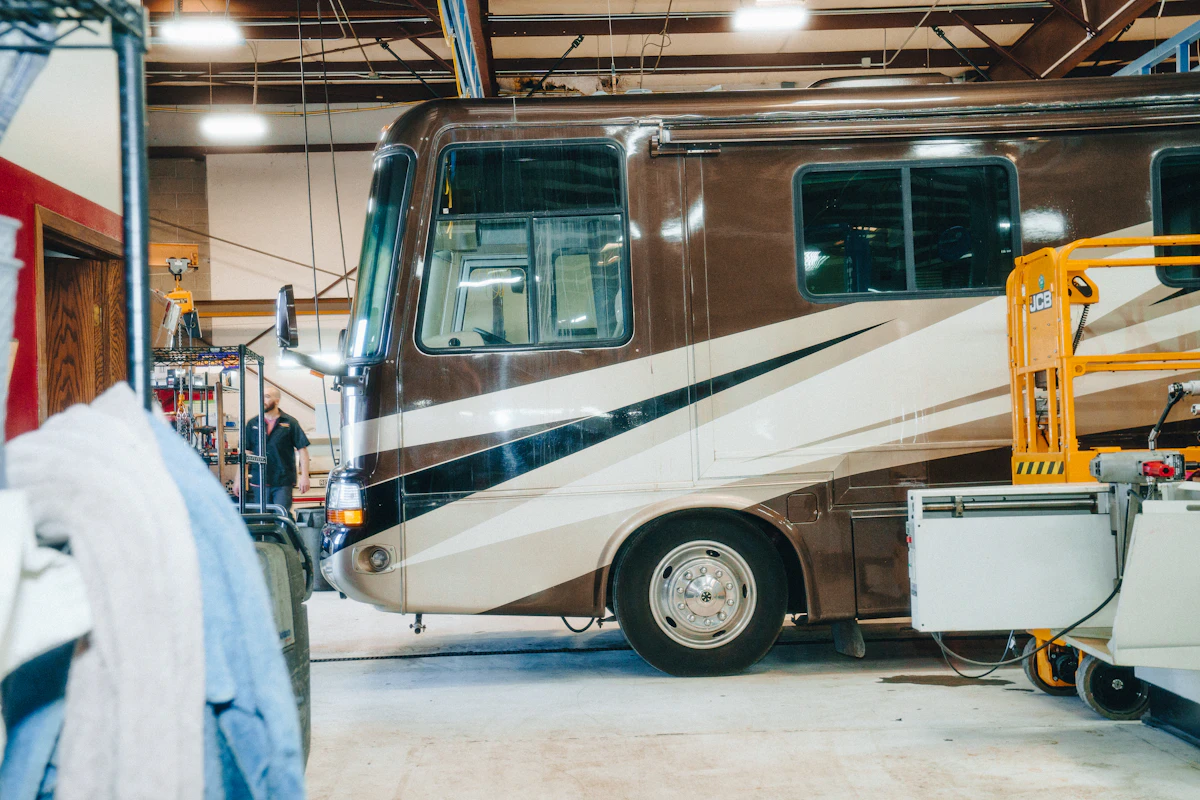
motorhome in a repair bay

Buyingan RV in Florida is different from buying one anywhere else in the country. Theclimate here does things to recreational vehicles that buyers from cooler,drier states do not expect. UV exposure degrades roofs, seals, and plasticsfaster than advertised. Humidity accelerates mold growth inside walls andcabinetry. Heat cycles weaken chassis components, AC systems, and slide-outseals on a timeline that can make a three-year-old unit look ten years old ifit spent those years sitting in South Florida sun.

Floridais also one of the largest RV markets in the country. There are a lot of unitsfor sale — from private sellers in Broward County and Palm Beach, to dealersthroughout the I-95 corridor. The volume of available inventory is a buyer'sadvantage, but it also means there is no shortage of units being sold withundisclosed problems that a proper pre-purchase inspection would catch.

Thischecklist covers every system a qualified inspector should evaluate before youcommit to buying an RV in Florida, the issues specific to the South Floridaclimate, and what to expect from a professional pre-purchase inspection at NHRepairs in Pompano Beach.

Why Florida Is Different

UV  radiation in South Florida is among the highest in the continental US. FEMA  flood zone classifications, high groundwater tables, and hurricane season  storage conditions add additional risk factors for RVs that have spent time  in this region. An RV inspection in Florida must account for all of these —  not just the standard checklist that applies to northern markets.

Why a Pre-Purchase Inspection IsNon-Negotiable in Florida

Most RV buyers in Florida discover their unit's problems after the purchase — when the roof leaks during the first rainstorm, the AC fails during the first week of summer, or the slide-out stops retracting. By that point, the seller is gone and the buyer owns whatever the inspection did not catch.

A professional RV pre-purchase inspection by a qualified mechanic and RV technician covers every major system on the unit: chassis, drivetrain, roof and exterior seals, electrical, plumbing, LP gas, appliances, slide-outs, and interior structure. It takes two to four hours depending on unit size and produces a written report you can use to negotiate the price, request repairs, or walk away.

Theinspection fee — typically $200 to $500 — is not the cost of the inspection. Itis the cost of the information that lets you make a sound buying decision on apurchase that may be in the six-figure range. Skipping it to save a few hundreddollars on a $100,000 Class A motorhome is not a rational trade.

Florida-Specific Risk

RVs that  have been stored outdoors in South Florida for extended periods — even one or  two years — are at high risk for roof membrane delamination, caulk joint  failure, and mold inside wall cavities. These issues are often not visible  without a systematic inspection and may not be disclosed by private sellers.

The Complete RV Pre-PurchaseInspection Checklist

Usethis checklist as a reference for what a qualified inspector should cover.Items marked with a Florida-specific note represent conditions or failure modesthat are more prevalent or more severe in the South Florida climate.

🏠  Roof & Exterior Seals

☐  Roof membrane condition

Check for bubbling, cracking, or separation — common on EPDM  and TPO roofs after Florida UV exposure.

⚠ Florida-specific: UV degradation accelerates membrane  failure. Inspect seams and seals around all roof penetrations.

☐  All roof seams and caulk joints

Every seam, vent, skylight, and antenna penetration should be  sealed without cracking or lifting.

☐  Roof vent and skylight seals

Commonly missed on inspections; a failed skylight seal causes  interior water intrusion.

☐  AC unit mounting and roof seal

AC units shift over time. Check the mounting gasket for  compression and the roof seal around the curb.

☐  Sidewall seam seals and body caulk

Walk the entire perimeter. Any dried or cracked caulk at wall  joints is a water intrusion path.

☐  Slide-out seals and wiper seals

Check all four sides of each slide-out. Torn wiper seals allow  water and insects inside.

⚠ Florida-specific: Slide-out seals degrade faster in Florida  heat and direct sun.

☐  Exterior compartment door seals

Check for seal compression and any rust or moisture damage  inside storage bays.

☐  Awning fabric and hardware

Check for tears, mold, and hardware corrosion. Motorized  awnings: test extension and retraction.

⚠ Florida-specific: Mold on awning fabric is common from  Florida humidity.


🏗  Interior Structure & Water Damage

☐  Soft spots on floor (all areas)

Walk slowly across the entire floor pressing firmly. Soft  spots indicate delamination or rot beneath.

⚠ Florida-specific: Water intrusion from Florida rain events  is the leading cause of floor delamination in used RVs.

☐  Wall delamination (exterior walls)

Press on exterior walls from inside. Any flex beyond normal  indicates delamination.

☐  Ceiling panels for water stains

Water stains may be old or ongoing. Inspect above any visible  staining.

☐  Slide-out floors and walls

Slide-outs are the most common site of ongoing water  intrusion. Inspect floor and wall bases inside each slide.

☐  Cabinet bases and lower cabinetry

Open every lower cabinet. Check bases for soft spots,  staining, or mold.

☐  Bathroom floor around toilet and shower

Water damage around the toilet base and shower pan is common  and often undisclosed.

☐  Basement compartment floors (if applicable)

Check for standing water, mold, and structural deterioration.

☐  Visible mold or mildew

Check closets, under mattresses, and around windows.

⚠ Florida-specific: South Florida humidity creates ideal mold  conditions in improperly ventilated RVs.


🔧  Chassis & Drivetrain (Motorhomes)

☐  Engine oil condition and level

Check color and viscosity. Dark, gritty oil indicates deferred  service intervals.

☐  Coolant condition and level

Check concentration and color. Discolored coolant suggests a  coolant exchange has been deferred.

⚠ Florida-specific: South Florida heat accelerates coolant  degradation. Check service history carefully.

☐  Transmission fluid condition

Dark or burnt-smelling fluid indicates deferred service or  internal wear.

☐  Belt and hose condition

Check for cracking, glazing, and wear on all belts. Check  hoses for softness and cracking.

⚠ Florida-specific: Florida heat accelerates rubber  degradation — especially on units stored outdoors.

☐  Exhaust system for leaks

Check from manifold to tailpipe. Any exhaust smell inside the  cab is a safety concern.

☐  Fault code scan (OBD/engine ECM)

Scan for active and inactive fault codes. Many sellers clear  codes before listing.

☐  Brake system — pads, lines, and fluid

Check pad thickness, line condition, and fluid color. Air over  hydraulic systems need additional checks.

☐  Steering components

Check for play, binding, and fluid leaks. Power steering fluid  condition.

☐  Generator hours and service history

High generator hours with no service records is a significant  risk.

⚠ Florida-specific: Generators run frequently in Florida for  AC. High hour generators are common in South FL units.

☐  Leveling system (hydraulic jacks)

Extend and retract all jacks. Check for leaks, slow operation,  and warning codes.


⚡  Electrical Systems

☐  Shore power connection and 30/50 amp hookup

Test at campsite or with a plug-in tester. Check for reverse  polarity or open ground.

☐  All 120V outlets

Test every outlet with a plug-in tester. Failed outlets often  indicate wiring issues.

☐  All 12V DC circuits and lighting

Test every interior light, exterior running light, and 12V  outlet.

☐  Battery bank condition and age

Check battery age (label date), charge state, and terminal  corrosion.

⚠ Florida-specific: Florida heat accelerates battery sulfation  and water loss in lead-acid batteries.

☐  Inverter/converter operation

Test both functions. A failing converter will not maintain  battery charge.

☐  Solar panels (if equipped)

Test output and charge controller operation. Check panel  mounting and wiring condition.

☐  Slide-out motor operation (electric)

Test each slide multiple times. Check for hesitation, noise,  or error codes.

☐  Slideout control panel and wiring

Inspect for corrosion, especially in units stored near coastal  areas.

⚠ Florida-specific: Salt air corrosion on electrical  components is accelerated in coastal South Florida locations.


🌡  AC, Plumbing & LP Gas

☐  Roof AC cooling performance

Run each AC unit for 15 minutes. Check supply air temperature  (should reach 60–65°F in moderate heat).

⚠ Florida-specific: AC reliability is critical in Florida. A  marginally performing unit will fail in South Florida summer.

☐  AC filter and coil condition

Remove filter and inspect. Check coil for mold and debris  buildup.

☐  Heat pump operation (if equipped)

Test heat mode. Less critical in Florida but indicates overall  AC system health.

☐  Fresh water system — pump and pressure

Test pump operation and check all faucets for flow and  pressure.

☐  Water heater operation (electric and LP)

Test both heating modes. Check anode rod condition if  accessible.

☐  All interior faucets, shower, and toilet

Check for leaks at connections and drain properly.

☐  Gray and black tank valves

Operate all dump valves. Check for resistance or leaking valve  seals.

☐  LP gas system — regulator and lines

Check regulator date (replace if over 10 years old). Check all  LP connections with soapy water for leaks.

☐  LP appliances — stove, oven, refrigerator

Test all burners and oven. Check refrigerator operation on  both LP and electric modes.

☐  LP detector and CO detector

Test both detectors. Check manufacture date — detectors have a  5–7 year service life.

☐  Smoke detector

Test operation. Replace if over 10 years old.

What to Budget for Repairs Aftera Florida RV Inspection

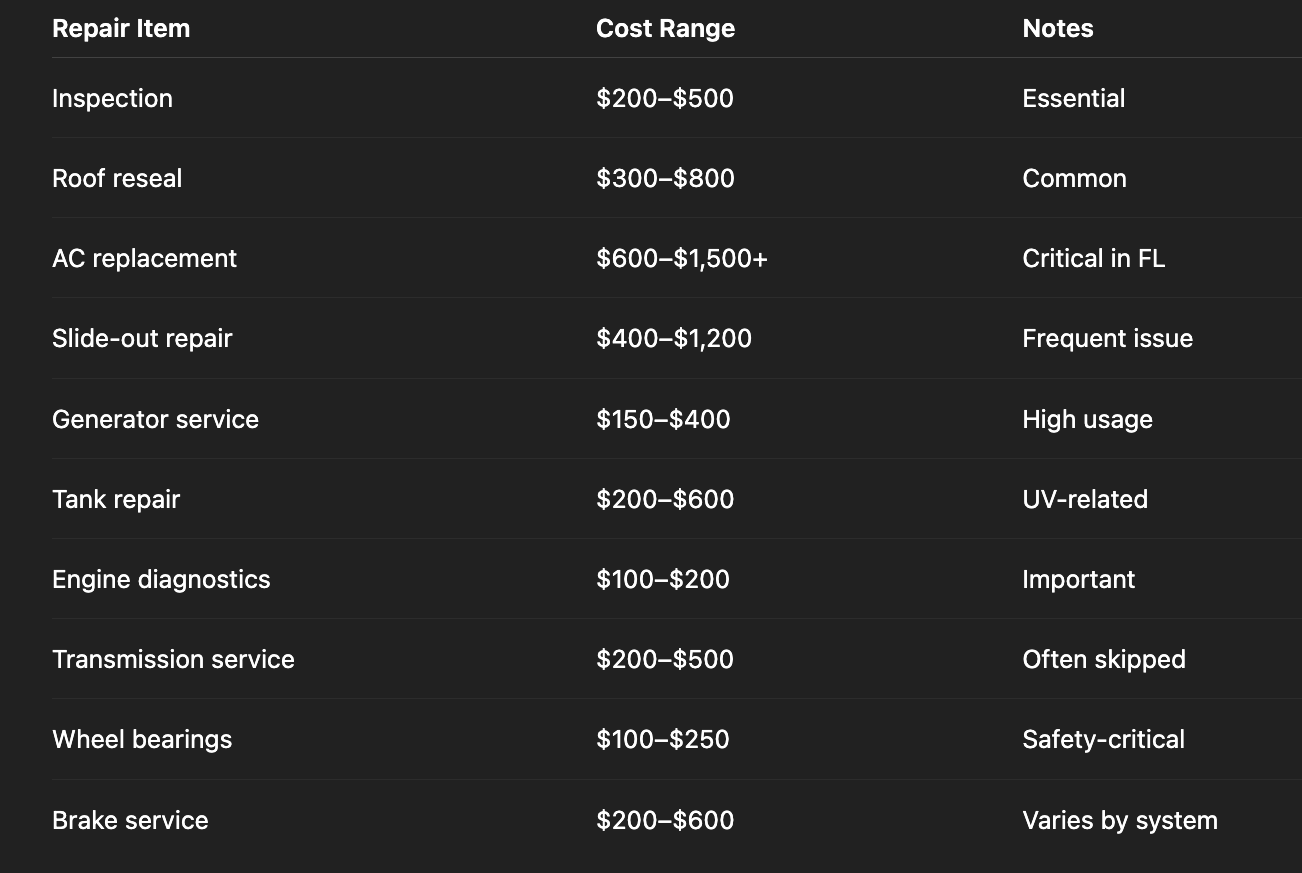
A pre-purchase inspection on a used RV in Florida almost always turns up something. The question is whether the findings are routine maintenance items or structural or mechanical problems that change the value of the unit. Here is a realistic cost reference for the most common repair categories in South Florida.


Service Item

Est. Cost

Why It  Matters in Florida

Professional  RV Pre-Purchase Inspection

$200 –  $500

Strongly  recommended — catches hidden issues before purchase

Roof  Reseal / Recoat

$300 –  $800

Common in  Florida due to UV degradation

AC Unit  Replacement (roof)

$600 –  $1,500+

Florida heat  makes AC reliability critical

Slide-Out  Motor/Seal Repair

$400 –  $1,200

Common failure  on older Class A/C units

Generator  Service

$150 –  $400

Required for  Florida summer off-grid camping

Fresh/Gray/Black  Tank Repair

$200 –  $600

Cracks common  after UV exposure

Chassis  Engine Diagnostic

$100 –  $200

Essential for  Class A (Freightliner/Spartan chassis)

Transmission  Service

$200 –  $500

Often deferred  by private sellers

Wheel  Bearing Inspection

$100 –  $250

Critical on  trailer and fifth-wheel axles

Brake  System Service

$200 –  $600

Air brakes on  larger Class A; hydraulic on smaller units


Negotiation Tip

A  professional inspection report with documented repair items is the strongest  negotiating tool a buyer has. In most private-party transactions, a repair  estimate from a shop is sufficient to negotiate a price reduction. Sellers  who refuse to allow a pre-purchase inspection should be treated as a red  flag.


Florida-Specific Issues to WatchFor

Hurricane Storage Damage

RVs that have been stored through one or more hurricane seasons in South Florida —particularly units that sat uncovered or were moved during storm preparations —may have sustained wind, rain, or falling debris damage that was repaired cosmetically without addressing the underlying structure. Ask sellers specifically whether the unit was ever damaged in a storm and whether an insurance claim was filed.

Flood and Water Table Exposure

South Florida's high water table means that RVs stored on low-lying properties, in areas that flood seasonally, or in spots without adequate drainage may have had their chassis, undercarriage, and lower storage compartments in standing water. Rust, corrosion, and electrical damage from repeated water exposure is often invisible until a full inspection is performed.

Sun-Faded and UV-Damaged Exteriors

Fiberglassand painted aluminum exteriors that have been in direct Florida sun for yearswithout protective treatment develop oxidation, chalking, and micro-cracking.These are cosmetic issues that do not affect function but are expensive toprofessionally restore. Factor the condition of the exterior into your offer.

Mold Behind Walls

Wall cavity mold from undetected water intrusion is one of the most expensive and disruptive repairs on a used RV. It is also one of the hardest to detect without a moisture meter and thermal imaging. A qualified inspector using a moisture meter can identify elevated moisture levels in walls and ceilings that have no visible signs of damage. Units with a history of roof or slide-out leaks should be inspected specifically for wall cavity moisture.

Strongly Recommended

For Class  A motorhomes in Florida, request a moisture meter and thermal imaging  inspection in addition to the standard visual and mechanical inspection. The  additional cost — typically $50 to $100 extra — is one of the most  cost-effective upgrades to an RV inspection in this climate.

RV Pre-Purchase Inspections atNH Repairs

NH Repairs performs pre-purchase RV inspections at 2221 NW 22nd St, Pompano Beach, FL 33069. The shop inspects Class A motorhomes (including units on Freightliner, Spartan, and Ford chassis), Class B and Class C motorhomes, fifth wheels, and travel trailers.

The inspection covers all systems outlined in this checklist: chassis and drivetrain, roof and exterior seals, interior structure and water damage, electrical, AC and HVAC, plumbing, LP gas, appliances, and slide-out operation. A written inspection report is provided after every inspection.

If you are considering a used RV purchase anywhere in South Florida and want an independent assessment before you commit, call 954-982-6710 to schedule an appointment. Bring the unit to the shop or inquire about mobile inspection availability for units that cannot be easily transported.

Customer Testimonials

"What a find! I cannot believe that having a service done on my RV could be such a pleasure! Adan and his team are professional, fast and to the point, and so friendly, service with a smile. Fantastic job guys, appreciate you getting my RV serviced and inspected in just a few hours, awesome!"

Barnard Meyer

"I had been having trouble getting the front end aligned properly on my class a motorhomeat St. Lucie battery automotive and I got tired of it so I went to Nationwide Haul, They Did a perfect job in one day where it took Camping World® and st. Lucie battery and tire  six months and they still couldn’t get it done. I recommend these guys highly. And they corrected the steering wheel that was at a drastic angle ,again I fully recommend these guys"

Mark Tooker

"I just bought a reefer trailer Matthew was my sales agent unfortunately my trailer a week after I bought it had an engine problem and they helped me without having any problems. Not only I enjoyed buying my 4th reefer from Nationwide Haul but once more they proved me how much they value their customers. I recommend this please if you need any commercial equipment.
Thank you again"

Carlos Rodriguez

Contact NH Repairs

Let us know what is going on with your vehicle, and we will get back to you soon with a quote.

Contact Information

Hours

Mon - Fri: 8:00AM - 5:00PM

Location

2221 NW 22nd St, Pompano Beach, FL 33069, United States
View Larger Map

Contact Form

* indicates a required field
Thank you! Your submission has been received!
Oops! Something went wrong while submitting the form.
By providing a telephone number and submitting this form, you consent to receive SMS text messages about support from NH Repairs. Message frequency may vary. Message and data rates may apply. You can reply STOP to opt out of further messaging and HELP for assistance or call 954-982-6710. Please review our Privacy Policy and Terms and Conditions.